
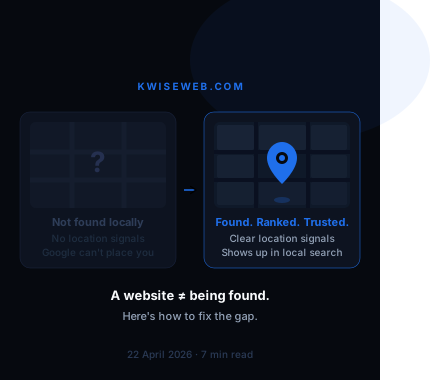
Having a website is not the same as being found
A website that exists but does not appear in local search is basically a very expensive business card that nobody sees. For local trades and service businesses, the gap between having a site and being found is where most of the lost enquiries happen.
When someone types "electrician near me" or "boiler repair in Swindon" into their phone, Google is not choosing results at random. It is looking at relevance, location signals, and how clearly each page answers that exact search. If your site talks about "quality electrical services" but never says where you work, Google has very little to work with.
That is why larger firms and directories show up so often. Their sites are built deliberately around local intent. The advantage smaller businesses have is real local presence. If the site reflects that clearly, it can compete far better than most owners expect.
The pages that matter most
You do not need a huge website. You need the right pages, written clearly and tied to what people actually search for.
That usually means a home page explaining who you are, what you do, and where you work. It means a services section with one page per core service rather than everything piled into one long page. It also means an about page that feels human, a contact page that works well on a phone, and some clear mention of the areas you cover.
Reviews matter as well. Genuine feedback from customers in your area helps new visitors trust you and gives search engines more context about where your business is active.
What local SEO means in practice
Local SEO sounds more technical than it really is. In practice, it is mostly about clarity and consistency.
Your service area needs to appear naturally in the copy across your main pages, footer, and contact details. Your Google Business Profile needs to match the name, phone number, and address details shown on the site. Your reviews need to be recent enough that a potential customer does not wonder whether the business is still active.
Those basics do a surprising amount of the heavy lifting. Most local businesses are not losing because a competitor has some secret SEO trick. They are losing because their own location signals are thin, vague, or inconsistent.
If you cover more than one area
You do not need a separate website for every town you work in. One domain is fine. The key is deciding which locations matter enough to deserve their own pages.
Those pages should not be thin duplicates with the place name swapped out. They should mention the kinds of jobs you do there, the parts of the area you know, and proof that you really work there. That takes more effort than mass-producing template pages, but it is the version that tends to hold up.
Your site has to work on a phone
Most people looking for a local tradesperson are doing it on a phone, often while they are in the middle of the problem. If the site is slow, hard to scan, or makes the phone number awkward to find, the enquiry often disappears before you even know it was there.
It is worth opening your own site on your phone and checking it as if you were a new customer. Is the service clear in the first few seconds? Can you tap to call without hunting around? Is the contact form short enough that somebody would actually use it on a small screen?
Making it easy to get in touch
A lot of local service websites lose enquiries at the final step because they make contact feel harder than it needs to be. A visible phone number, a short form, and a quick follow-up do far more work than most design flourishes.
The form does not need to collect everything. Name, contact details, and a brief outline of the job is usually enough. If you add a confirmation email or a WhatsApp option, the customer gets immediate reassurance that their message has landed properly.
What a decent local service website looks like
Take a domestic electrician covering Reading and the surrounding villages. A useful site for that business might include a home page that names the coverage area clearly, service pages for rewiring, fuse box upgrades, and emergency call-outs, an about page with a team photo and accreditation, and a contact page with a three-field form plus click-to-call.
Nothing about that setup is flashy. It just answers the questions a local customer has before they enquire, and it gives Google enough context to understand what the business does and where it works.
If you want help sorting this properly, the small business website design service page shows how Kwise Web structures this kind of local service site.
If you already have a site and it is not performing
A poor-performing site does not always need a full rebuild. Sometimes the issues are structural rather than visual.
Look at whether your service areas are mentioned clearly on the main pages, whether each core service has its own page, whether the contact path is obvious on mobile, and whether the site relies too heavily on stock imagery and generic wording. A few focused changes can make a bigger difference than a full redesign done for the wrong reasons.
How long it takes to see results
A new or improved site can start appearing in search results within a few weeks, but stronger local rankings usually take longer. A few months is a more honest expectation, especially in competitive trades or crowded towns.
The businesses that improve steadily are usually the ones that keep their Google Business Profile current, collect reviews consistently, and make occasional updates to the site instead of treating it as a one-off project.