
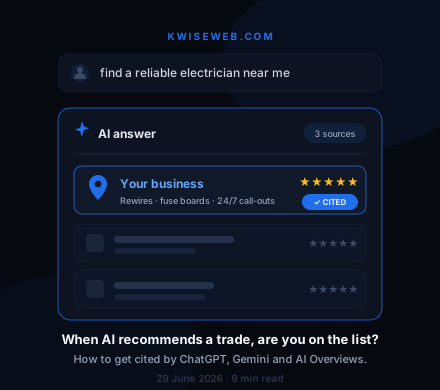
AI search is becoming a new front door for local work
The way people find a tradesperson is shifting. A growing share of searches now happen inside an AI assistant, which replies with a recommendation rather than a list of ten blue links. For a local customer, that answer is often the whole shortlist. They may never see the rest of the results at all.
This still represents a smaller slice of total search than Google's classic results, but it is growing quickly, and the searches assistants handle best are exactly the ones trades care about: local, specific, and close to action. A person asking an assistant for a plumber in their town is usually ready to act, not idly browsing.
The problem for most businesses is that they are not part of that conversation yet. A January 2026 review of 100 UK small businesses reported that only three of them appeared at all when the businesses were searched for in ChatGPT. Most firms are simply absent from AI answers, which means the opportunity is wide open for the ones that prepare for it early.
Being on the web is not the same as being quoted
Most trade websites are brochure sites. A home page, a services page, a contact form, all built to be read by a person who has already found the business. AI works differently. It reads across many sources at once and lifts the clearest, most self-contained statements it can find to build its answer.
If your site never plainly states what you do, where you work, and why you can be trusted, the model has very little it can quote. It cannot recommend a business it cannot confidently describe. Vague wording like "quality electrical services you can trust" gives a model nothing to work with.
So the gap is rarely about design. It is about clarity and structure. The sites that get cited tend to be the ones that make the important facts easy to find and easy to repeat.
Strong local SEO is still the foundation, not the opposite of it
There is a common myth that AI search has replaced SEO. In practice, AI leans heavily on the same signals that already decide normal search results. Studies disagree on the exact figure, and estimates have moved around through 2026 as the way researchers measure citations has improved, but they point the same way: pages that already rank well in ordinary search are far more likely to be the ones AI quotes.
Assistants also do not read your website in isolation. They synthesise an answer from your Google Business Profile, your reviews, and local citations as well as your site. That means the local search basics still do much of the heavy lifting: a complete, accurate Google Business Profile, consistent business details, and recent genuine reviews.
The useful way to think about it is layered. Classic local SEO is the foundation. Optimising for AI answers is the next layer on top of it, not a replacement for it. Skipping the foundation and chasing the AI layer rarely works.
Answer the question directly, in the first line
AI assistants extract clean, direct answers and tend to ignore the wind-up. The practical lesson is to lead each page, and each section, with a plain answer and then support it underneath.
A service page that opens with "We are a Leeds electrician covering LS postcodes for rewires, fuse box upgrades, and emergency call-outs" gives a model something it can lift word for word. A page that opens with a slogan does not. The first sentence is doing more work than it used to.
This is also why a genuine FAQ is some of the most quotable content a trade site can publish. Clear questions and short, direct answers about cost, coverage, timing, and qualifications match how people phrase things to an assistant, and they are easy for a model to reuse.
Give AI the facts in a form it can lift
Structured data, often called schema, labels your business details so machines can read them reliably rather than guessing. Marking up your business type, service area, opening hours, reviews, and FAQ helps search engines understand the business, and the same structure helps AI assistants pull the right details into an answer. Google's own guidance is clear that this kind of markup helps it understand a local business.
Consistency matters just as much. Keep your business name, address, phone number, and service area identical across your website, your Google Business Profile, and any directories. When those details conflict, a model has less reason to trust any single version, and you are more likely to be left out of the answer.
If you want a site built to be understood by both customers and AI, the trade website design service page shows how we structure clear service pages, real local detail, and the proof that helps a business get found.
Reviews and outside mentions decide whether you make the shortlist
An assistant does not only read what you say about yourself. It weighs what other sources say too. Recent, genuine reviews and mentions across directories and local sites all feed the picture it builds, and a business with steady, credible proof is easier to recommend with confidence.
This is also why directories and review platforms still matter even as their role shifts. Assistants increasingly draw on them when assembling a local recommendation, so spreading honest proof across the places customers and machines both check is worth the effort. BrightLocal's 2026 research found consumers now rely on several review and research channels rather than one, which is a useful reminder not to put everything in a single basket.
Your own website still sits at the centre
AI changes the front door, not the destination. Once a customer has a name from an assistant, they still tend to check the business's own site to judge whether it covers their area, takes on their kind of job, and looks established enough to call. The decision still lands on your website.
Your site is also the one asset you fully control, and it is the clearest place to publish the structured, answer-first content that AI quotes in the first place. Relying only on a profile or a directory leaves the same gaps it always has, and now those gaps also limit how well an assistant can represent you.
What a trade business should do first
Start by making each core service and your service area obvious in plain English, ideally on their own pages rather than buried in one long catch-all page. Add an honest FAQ that answers the questions customers actually ask. Add LocalBusiness and FAQ structured data so the details are machine-readable. Keep your name, address, and phone number consistent everywhere, and keep your Google Business Profile complete with recent reviews.
Then do the simplest test of all. Open ChatGPT, Gemini, or Google's AI features and ask them to recommend a business like yours in your town. Whatever they get wrong, or leave out, is your to-do list. The businesses that act on that list now are the ones that will be named while everyone else is still invisible.